

SHOPWARE + ACRO COMMERCE
Is Shopware right for complex B2B? Depends on the architecture.
Most B2B commerce projects don’t fail on the platform. They fail because business logic, pricing rules, approvals, and ERP constraints were never mapped before the platform was picked. Shopware is a strong answer for a specific kind of complexity. This page is how to tell if yours is that kind.
The thesis
Shopware doesn’t fix the wrong architecture.
The platform doesn’t matter until you understand the business logic.
That belief runs through everything we build, and it’s why this page won’t tell you Shopware is right for you until we’ve been straight about when it’s wrong.
Open architecture earns its keep where the business has operational truth that won’t bend: pricing an API can’t express, a dealer network that needs its own portal, an ERP that has to stay the single source of truth. In that situation, a flexible platform is a foundation. Without it, you’re paying for overhead you’ll never use.
From our CEO
Commerce, built for manufacturing reality.
Shae Inglis on why manufacturers keep outgrowing out-of-the-box platforms, and what changes when you build the commerce experience around how the business really runs.
1998
Building B2B commerce since
90+
People focused on complex commerce
When Shopware is the right call
Three situations where Shopware earns the call.
Standard SaaS platforms are fast, and for plenty of businesses they’re the right choice. Shopware’s open architecture pays for itself in three situations.
Catalogs that break other platforms
Pain
Millions of SKU variations, configurable products, and unit-of-measure conversions that hit the ceiling on standard APIs.
Fit
Handles massive, configurable catalogs without choking and keeps pricing and product logic in one place.
Regulated goods and data sovereignty
Pain
Strict compliance, and a need to control exactly where data lives. That's hard to guarantee on shared SaaS.
Fit
Full control over the database and infrastructure. No shared environments you can't see into.
Dealer and distributor networks
Pain
Distributors and branches demand their own portals with unique pricing, budgets, and role-based permissions.
Fit
Shopware's native B2B capabilities model corporate hierarchies, budgets, and permissions without a custom rebuild.
Brands that run on Shopware at scale.




WHEN TO PASS
Shopware is overkill for plenty of businesses.
If your catalog is straightforward, your pricing fits inside a standard API, and you don’t run a dealer network, Shopware is more than you need.
A simpler SaaS option will get you live faster and cost less to run. We’ll tell you that before you spend a dollar with us. That’s not a disclaimer, it’s the whole point. The clients who get the most out of working with us are the ones who showed up unsure and left knowing exactly why their choice made sense.

"We immediately fell in love with the scrappy nature, the willingness to get a solution across the line for a customer. They were getting back to us faster than we were getting back to them, which is an absolute anomaly.
It wasn't the empty promises you typically get. It was the follow-up and follow-through. They came in full guns blazing, and they haven't let off the gas pedal since."
— Shae Inglis, Founder & CEO, Acro Commerce
A new partnership, kept honest
We're early with Shopware. We're not hiding it.

We'd rather show you how we think than borrow a wall of logos we didn't earn. Our first Shopware projects are in flight, and the named case studies aren't public yet. What sits behind them isn't new, though: twenty-eight years of building ERP-connected B2B commerce. That's the part Shopware runs on top of.
What we can show you today
- 28 years of B2B commerce architecture across Acumatica, Cin7, and Shopware ecosystems.
- Celeste, our platform-fit diagnostic — map your business logic against the architecture before you commit.
- ERP-connected builds that killed the swivel-chair data entry and kept the ERP as the source of truth.
What's landing through 2026
- First named Shopware case studies as our initial builds go live and clearances come through.
- The Shopware × Acumatica integration — purpose-built for complex B2B, launching this year.
- Published write-ups on the architecture calls we made, and why.
Want to be a reference build?
Talk to a solution architect about early Shopware work.
The discipline, demonstrated
Until the Shopware case studies land, the method is the proof.
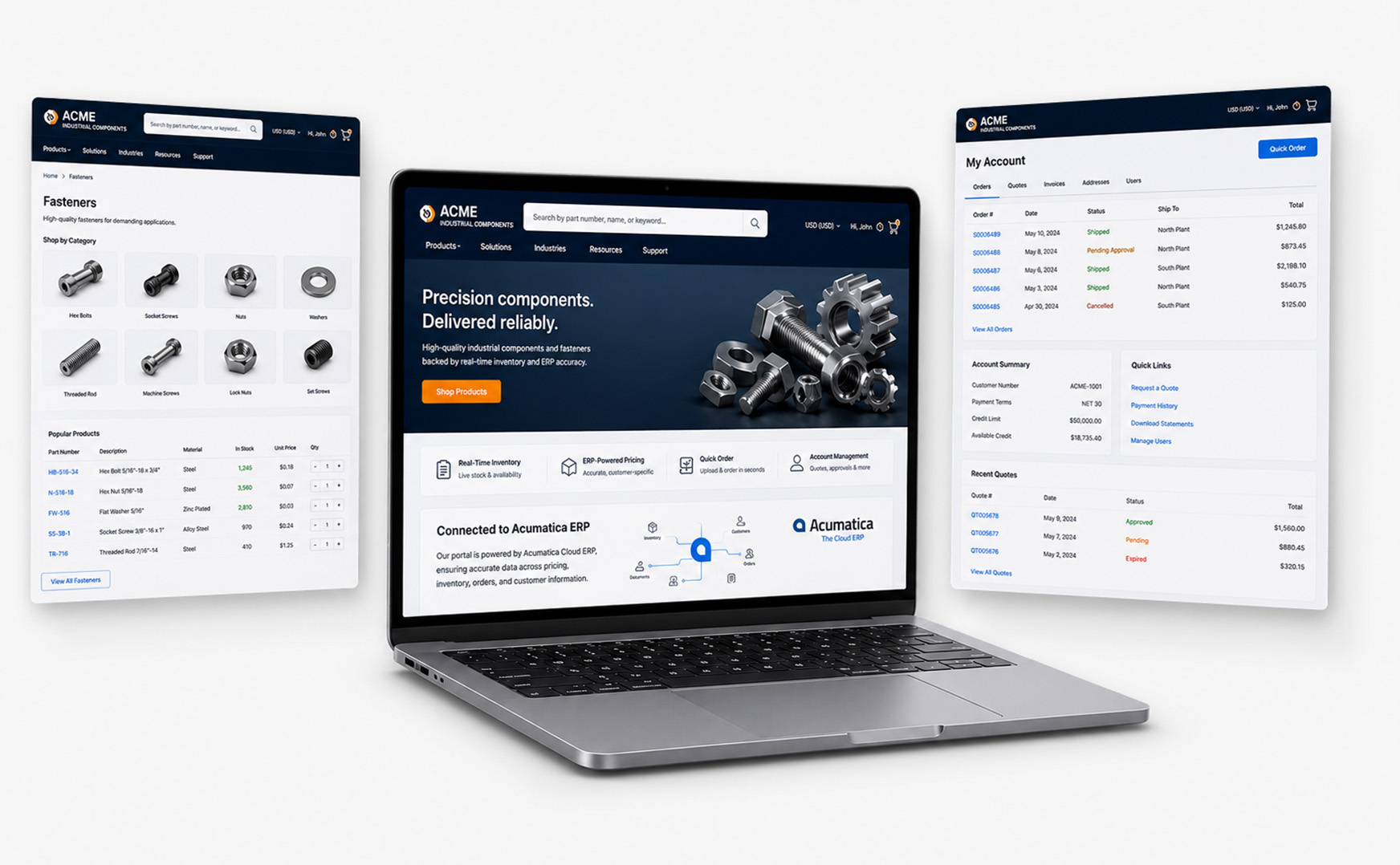
- ERP-connected
- Bidirectional sync
- Pricing & inventory
- No swivel-chair entry
A manufacturer was running a cloud ERP and a separate commerce front-end that didn't talk to each other.
We built a real-time, two-way integration so orders, pricing, and product data sync on their own, in both directions. The manual re-entry that had been quietly eating the team's week went away.
That build wasn't on Shopware, which is exactly why it's here. The starting point doesn't change with the platform. We work out how the business prices, approves, and ships before touching the technology, then make the technology follow. The Shopware work runs on the same approach.
*The linked case study is an Acumatica-connected build, not a Shopware build.
We're sharing this example as evidence of our method.
**Screens displayed are for illustrative purposes.
THE FIT CHECK
Find out before you pick a platform.
Feed Celeste your business logic and get an architecture-first read on whether Shopware, something simpler, or something in between fits how you really operate.